 Home
Home Landlords
 Tenants
 About
About Contact
 Contractors
 Blog
Blog Available Properties
 Book a Valuation
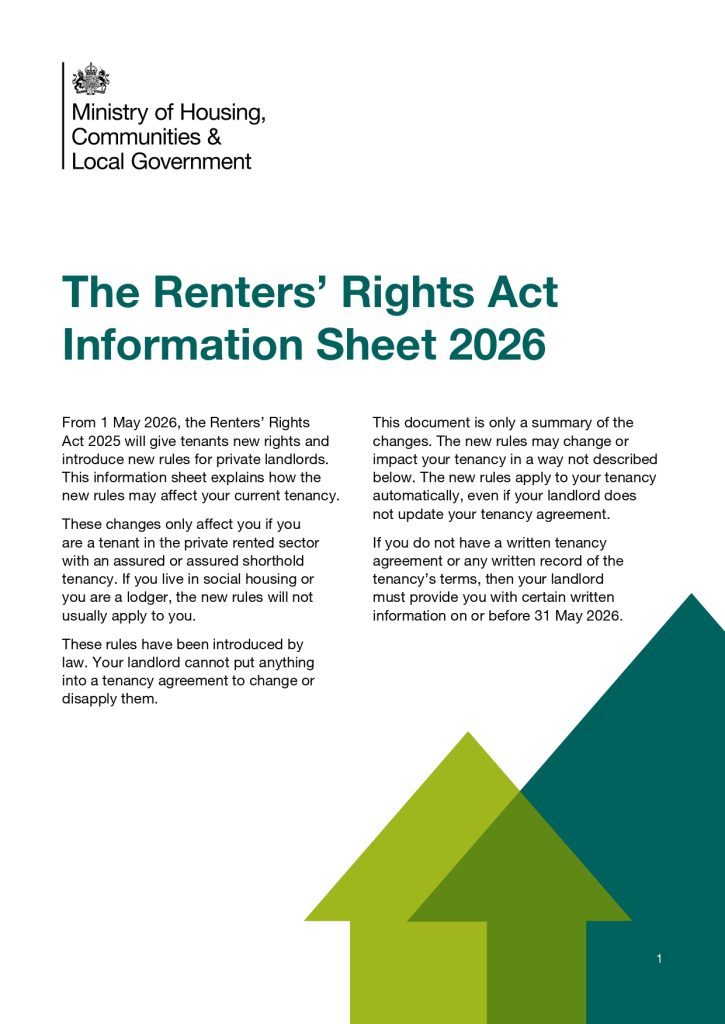
The government has officially released the Renters’ Rights Act Information Sheet 2026, and if you’re a private landlord with tenants in the private rented sector, this one is not optional. Every tenant with an assured or assured shorthold tenancy needs to receive a copy of this document — and the deadline is 31st May 2026.
Miss it, and you could be looking at a fine of up to £7,000. So let’s talk about what’s in it, why it matters, and why getting this done now — rather than scrambling in May — is absolutely the right move.
What Is the Information Sheet?
Produced by the Ministry of Housing, Communities & Local Government, this four-page document summarises all the key changes the Renters’ Rights Act 2025 brings in from 1st May 2026. It’s written for tenants, so they understand their new rights. But the obligation to get it into their hands? That sits firmly with you, the landlord.
Here’s a quick summary of what the document covers, so you know exactly what your tenants are being told:
Fixed term tenancies are gone. From 1st May 2026, all assured tenancies automatically become rolling (periodic) tenancies. Any end date in your current tenancy agreement will no longer apply. Tenancies will usually roll monthly unless a shorter period was agreed.
Assured Shorthold Tenancies are abolished. The AST as we know it disappears on 1st May 2026. All existing ASTs will automatically convert to Assured Periodic Tenancies. Nothing to do on your part for the conversion itself — but your tenants need to know this is happening.
Rent increases must follow the Section 13 process. Any rent review clauses in your current agreements? They’re no longer valid after 1st May 2026. Going forward, rent can only be increased once per year, with at least 2 months’ written notice using Form 4A, and any increase must not exceed open market rent. Tenants can challenge increases they feel are above market rate at the First-tier Tribunal.
Section 21 ‘no-fault’ evictions are abolished. From 1st May 2026, you cannot serve a Section 21 notice. To recover possession, you’ll need a valid legal ground under Section 8. Grounds include rent arrears, antisocial behaviour, wanting to sell the property, or a family member needing to move in — though the latter two cannot be used in the first 12 months of a tenancy.
Tenants’ notice period. Tenants must give at least 2 months’ notice to end their tenancy, in writing, timed to a rent due date.
Pets. Tenants now have the right to request a pet from 1st May 2026, and landlords cannot unreasonably refuse. Any refusal must be in writing with reasons.
Student landlords — there’s a specific action for you. If you let to full-time students and want to use possession ground 4A (end of academic year), you must have given your student tenants written notice of this by 31st May 2026. And importantly — the information sheet itself does NOT count as that notice. That needs to be a separate document.
Why You Shouldn’t Wait Until May
I know it’s tempting to think “I’ve got time.” But here’s the thing — if you manage multiple properties and multiple tenancies, that’s a lot of documents to track. Do it now while it’s front of mind, keep a record that it’s been sent, and you’re done. Sorted. Protected.
Because here’s what “waiting” risks: a rushed job at the end of May, missed tenants, no paper trail — and a potential £7,000 fine per failure to comply. That’s not a gamble worth taking.
One Very Important Point — Links Are NOT Acceptable
Please read this carefully: you cannot send your tenant a link to the PDF and call it done. The actual document must be provided. Send it as an email attachment, hand it over in person, or post it — but the PDF itself needs to reach your tenant. A URL is not sufficient.
Using a Letting Agent? Don’t Just Assume It’s Handled
If you have a managing or letting agent, please don’t assume this will just happen automatically. Chase them. Ask directly: “Are you sending the Renters’ Rights Act Information Sheet 2026 to all of my tenants before 31st May 2026?” And then ask for proof it’s been sent — a confirmation email, a delivery log, something in writing.
Ultimately, as the landlord, the responsibility is yours. Your agent acting on your behalf doesn’t remove your liability if the document doesn’t get through.
Your Quick Checklist
- Obtain the official Renters’ Rights Act Information Sheet 2026 PDF from GOV.UK
- Send it to all current private sector tenants with assured or AST tenancies — as an attachment, not a link
- If your tenant has no written tenancy agreement, also provide them with certain written tenancy information by 31st May 2026
- Keep records — email receipts, delivery confirmation, or signed acknowledgements
- If you use a letting agent — ask for written confirmation that it’s been sent to each tenant
- Student landlords — issue separate written notice about ground 4A if applicable (the information sheet doesn’t count!)
- After 1st May 2026, all new tenancies will be Assured Periodic Tenancies — make sure your new APT documentation is up to date and reflects the Act’s requirements
The Renters’ Rights Act is the biggest shake-up of the private rented sector in a generation. This information sheet is just one part of your obligations — but it’s a legal one with a hard deadline and a real fine attached. Get it done now, and let’s start May with one less thing to worry about!
Got questions about your obligations under the Renters’ Rights Act? Get in touch — I’m happy to help.