 Home
Home Landlords
 Tenants
 About
About Contact
 Contractors
 Blog
Blog Available Properties
 Book a Valuation
Missed the RRA Information Sheet Deadline? Here’s What Landlords Need to Know
A guide for private landlords in England — June 2026
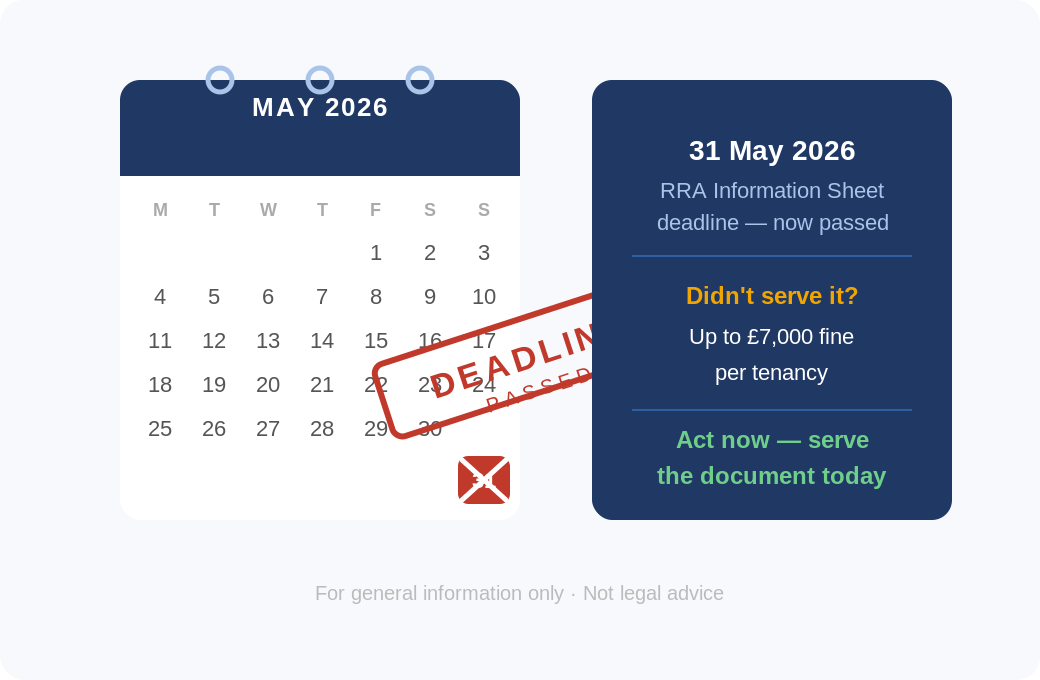
The 31 May 2026 deadline for serving the Renters’ Rights Act (RRA) Information Sheet has now passed. If you’re a private landlord in England and you didn’t get the document to your tenants in time, you’re not alone — but you do need to act quickly. This post sets out what the obligation was, what happens if you missed it, the potential consequences, and — crucially — what you can do right now to limit your exposure.
What Was the Obligation?
From 1 May 2026, the Renters’ Rights Act 2025 came fully into force, converting virtually all existing assured shorthold tenancies in England into the new periodic tenancy framework and abolishing Section 21 ‘no-fault’ evictions. To inform tenants of these changes, the government required landlords to serve the official “Renters’ Rights Act Information Sheet 2026” on every existing tenant by 31 May 2026.
The obligation applied if all of the following were true:
- The tenancy was an assured or assured shorthold tenancy.
- The tenancy was created before 1 May 2026.
- There is a wholly or partly written record of the tenancy terms.
- Every named tenant on the tenancy agreement required their own individual copy.
Only the official PDF document published on GOV.UK was acceptable. Sending a link to the PDF — by email or text — was explicitly not valid. The document had to be attached, printed, or hand-delivered.
What Are the Potential Consequences?
Failing to serve the Information Sheet by the deadline is a civil offence enforced by your Local Housing Authority (LHA). The penalties are significant.
Financial Penalties
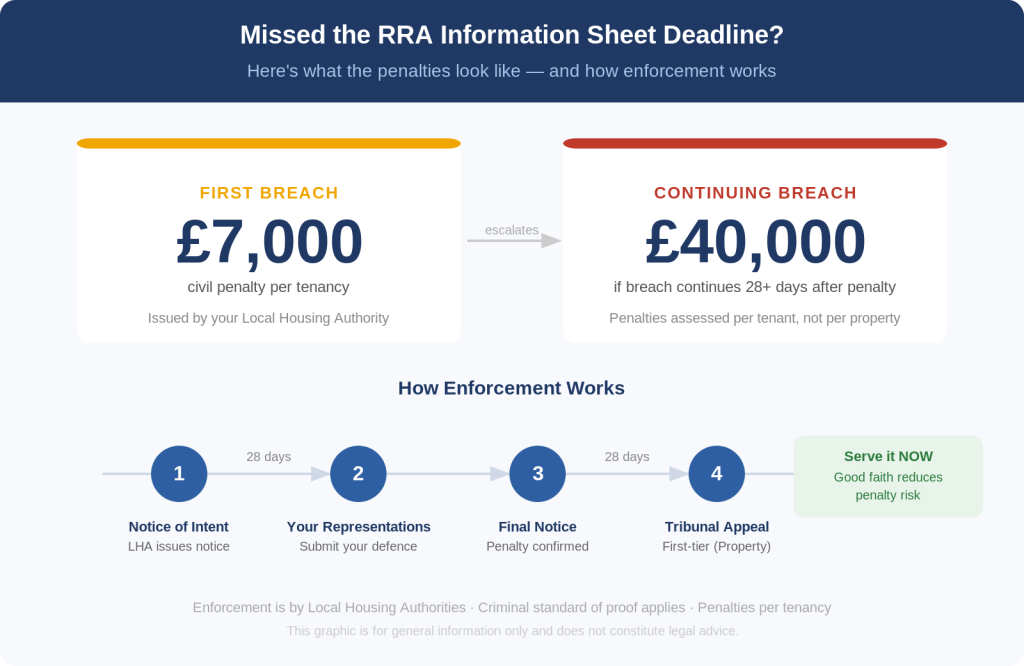
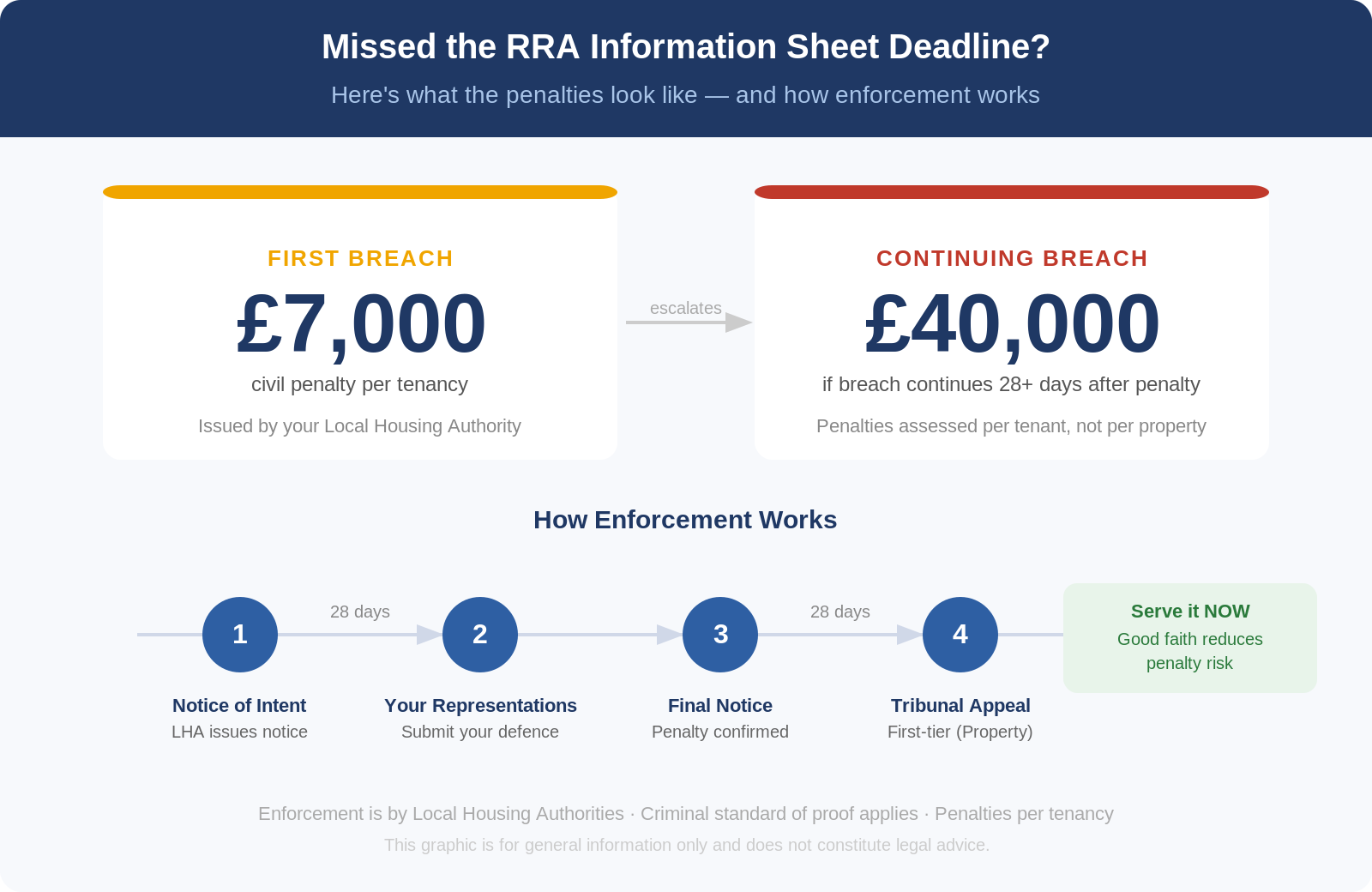
- First breach: A civil penalty of up to £7,000 per tenancy.
- Repeat or continuing breach: Up to £40,000. If a penalty has been issued and the breach continues for more than 28 days, it may be treated as a continuing offence, triggering this higher band.
- Per tenant, not per property: Penalties are assessed per tenancy, meaning a house in multiple occupation (HMO) with several named tenants could carry a proportionally higher risk.
Who Enforces It?
Local Housing Authorities now have a statutory duty to investigate and take action. The LHA must be satisfied ‘beyond reasonable doubt’ that a breach occurred — this is the criminal standard of proof, not the lower civil standard. That said, the LHA has broad investigation powers and can act on complaints from tenants.
The Penalty Process
If the LHA decides to act, the process works as follows:
- The LHA issues a Notice of Intent to impose a civil penalty.
- The landlord has 28 days to make representations (explain why the penalty should not be imposed).
- The LHA then issues a Final Notice.
- The landlord has a further 28 days from the Final Notice to appeal to the First-tier Tribunal (Property Chamber).
What Should You Do Right Now?
Missing the deadline is serious, but the worst thing you can do is nothing. Every day you delay increases your exposure. Here are the steps to take immediately.
1. Serve the Document Now — Today
Download the official “Renters’ Rights Act Information Sheet 2026” directly from GOV.UK (gov.uk/government/publications/the-renters-rights-act-information-sheet-2026) and serve it on every named tenant without delay. You can send it as an email attachment, post a hard copy, or hand-deliver it. Do not send a link — the document itself must be provided.
Serving the document late will not undo the technical breach, but it demonstrates active good faith and materially reduces the chance of a penalty being pursued or upheld at its maximum level.
2. Keep Detailed Evidence of Service
Evidence of how and when the document was served will be critical if an LHA investigation arises. For each tenant, record:
- The date and method of service (email attachment, post, hand delivery).
- Proof of delivery where possible (e.g. read receipt, recorded delivery receipt, signed acknowledgement).
- A copy of the exact document served.
3. Do Not Ignore Any Communication from Your LHA
If you receive a Notice of Intent from your Local Housing Authority, the 28-day window to make representations is your primary opportunity to reduce or avoid a penalty. Use it. Set out the circumstances clearly: when you discovered the error, the steps you took to remedy it, and any mitigating factors. Consider taking legal advice at this stage.
4. Prepare a Mitigation Argument
The LHA has discretion in setting the penalty amount, and the government’s civil penalties guidance makes clear that mitigating factors should be considered. Factors that may work in your favour include:
- You served the document as soon as you became aware of the requirement.
- You have no prior history of housing-related offences or penalties.
- You have a good track record as a compliant landlord.
- The breach caused no material harm to the tenant.
- There were genuine extenuating circumstances (illness, bereavement, system failure) that contributed to the delay.
5. Check Whether You Actually Had the Obligation
Before assuming you are in breach, verify the obligation applied to you. Landlords who had already served a valid Section 21 or Section 8 notice before 1 May 2026 had a separate one-month window. Fully verbal tenancies with no written terms may also fall outside the requirement. Review your specific circumstances carefully.
The Bigger Picture: Staying Compliant Going Forward
The Information Sheet deadline was just one of many new obligations introduced under the Renters’ Rights Act. Going forward, landlords need to be across a range of changes, including:
- The end of fixed-term tenancies and fixed-term assured shorthold tenancies for new lets.
- New grounds for possession under Section 8 (replacing Section 21).
- Strengthened tenant rights around rent increases and pets.
- The new Private Rented Sector Database, with registration requirements to follow.
Joining a landlord association such as the NRLA (National Residential Landlords Association) is one of the most effective ways to stay informed and avoid missing future deadlines.
Summary: Key Actions for Landlords Who Missed the Deadline
- Download the official RRA Information Sheet from GOV.UK immediately.
- Serve it on every named tenant as an attachment (not a link) — email, post, or hand deliver.
- Keep dated records and proof of delivery for every tenant.
- If you receive a Notice of Intent, use your 28-day window to make representations.
- Take legal advice if you have concerns about your specific situation.
Disclaimer: This blog post is for general information purposes only and does not constitute legal advice. If you have concerns about your specific circumstances, you should seek advice from a qualified solicitor or housing law specialist.